
Gelephu Mindfulness City in Bhutan, an urban project focused on mindfulness and development.
08/01/2026
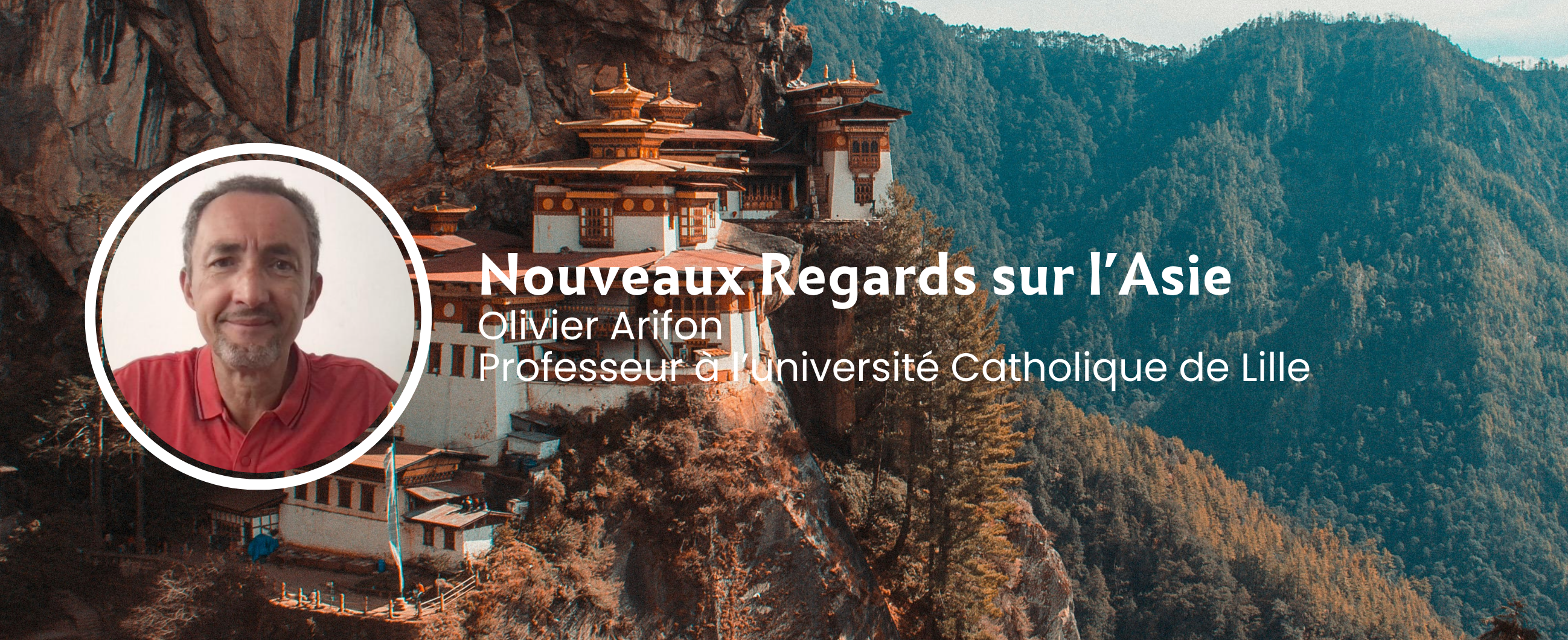
By Olivier Arifon
Does the GMC project serve to attract investors, or to offer a vision and hope to the country and, more broadly, to the sub-region? And with what values, and for which audiences? These are some of the elements at stake in Gelephu Mindfulness City. Bhutan is facing demographic, economic, and migration-related challenges. Rich in its culture and Buddhist philosophy, its economy remains largely agrarian; life can be difficult, and many young Bhutanese have left to seek opportunities elsewhere, notably in Australia.
Gelephu Mindfulness City therefore emerges as a hope-bearing response, both within and beyond the country. It is grounded in the values of Vajrayana Buddhism in order to propose a new model that fuses the economic imperative with Bhutan’s distinctive spiritual anchoring.
Planning and construction of Gelephu Mindfulness City, integrating the social and economic values of mindfulness, are planned through 2035. This choice to leverage the assets of mindfulness is, to our knowledge, unprecedented.
According to the official narrative, this initiative represents an expression of the core values of Gross National Happiness (GNH), which made Bhutan known internationally. The index—better known by its English acronym GNH (Gross National Happiness index)—draws inspiration from Buddhist philosophy and rests on four pillars: sustainable and equitable development, preservation of culture, environmental protection, and good governance.
Thus, GMC, GNH, and mindfulness are interconnected. By way of reminder, mindfulness has established itself as a technique for well-being and personal development, thereby becoming a market proposition for individuals in search of meaning.
Within the GMC, the government highlights four objectives: “to offer skilled jobs and a future to citizens, cooperate with India in order to create a hub in this landlocked region, attract international investors, and become ‘a spiritual center for Buddhism.’” [1]
Why such a project in Bhutan? A look at the figures is enough: “Buddhists constitute the majority in seven countries: Cambodia (97%); Thailand (94%); Myanmar (89%); Bhutan (75%); Sri Lanka (70%); Laos (64%); and Mongolia (51%).” [2]
Bhutan thus combines a government closely linked to religion and a majority Buddhist population within the country. This provides a favorable context for choosing and supporting such a project.
GMC offer and content
The GMC’s economic offering is based on a vision—developed by the king—of a region endowed with political and economic autonomy. Communications around Gelephu Mindfulness City promise “a free-trade and investment policy, fair competitive conditions, the rule of law, full free movement of capital, a transparent and efficient public administration, moderate and simple taxation, a robust and efficient financial market (…), modern infrastructure (…), and a pool of qualified and multicultural talent.” [3]
To enhance its attractiveness, the country has chosen cutting-edge legal frameworks in the economy and finance, namely “Singapore common laws” [4] and the “Abu Dhabi Global Market Regulations” [5], which offer flexible, effective, and appealing frameworks for companies and investors.
In addition, in 2025, Bhutan organized the Global Peace Prayer Festival in Thimphu from November 4 to 19. This event brought together all branches of Vajrayana Buddhism, with around 70 masters and religious leaders.
Each of them was allotted two hours to present their text and rituals during the festival. As there are no Buddhist celebrations with international resonance (cf. World Youth Day or the pilgrimage to Mecca), Bhutan conceives of this festival as a pathway capable of making the country the driving force of the Vajrayana branch and a benchmark in matters of peace.
This type of event is a first, because while India, China, and Sri Lanka animate various religious, cultural, and political associations governing the three types of Buddhism, none of these countries is of Vajrayana tradition. In other words, this initiative makes it possible to develop primacy, even exclusivity, on this subject.
Through a gradual process, and thanks to various forthcoming events (unknown at this stage), projects will be implemented over ten, twenty, or thirty years within the GMC. Each master or school will be able to develop its monastery and practice centers, making the city a reference point for the various Vajrayana traditions, a place of unification and of religious and spiritual contact.
The political dimension is fully present. On the occasion of the 70th anniversary of the current king’s father, India sent two Buddha relics, and Prime Minister Modi came to participate in the central ritual on November 11. Through these ceremonies, the two countries convey a message of benevolence to the entire world—political action of a scale that is, if not international, at least regional.
Sub-regional connectivity constitutes the third factor. The GMC is located in the south-central part of the country, close to the Indian state of Assam. India signed an agreement to finance and build the first Kokrajhar–Gelephu railway link in order to open up Bhutan and connect the city to the sub-region, whose basin is estimated at around 300 million people.
Put differently, Gelephu could transform the geographic constraint of landlockedness into a logistical and economic advantage. In the long term, Bhutan aims to make the GMC a regional platform for cooperation: a space of economic neutrality where investors, NGOs, and international institutions could convene.
Questions and challenges
Each of these three axes has its limits. From a business perspective, at this stage it is difficult to know how this project distinguishes itself from other SEZs and city-states that have adopted an extremely economically liberal orientation. On paper, it appears to offer a variety of options, but it is still too early to assess the risks.
However, the choice of Abu Dhabi’s and Singapore’s ultra-liberal financial standards, along with the special status of the entire urban complex, may foster the emergence of a grey zone conducive to financial activities less virtuous than intended.
The economic and geopolitical stakes are major. The city is meant to serve as a lever for economic diversification, reduce dependence on hydropower and on the Indian neighbor, and attract foreign investment under state control.
Its sensitive geographic position places it at the heart of regional tensions, where diplomatic caution and a strategy of neutrality are essential to prevent Gelephu from becoming a site of rivalries.
The GMC may also resemble an enclave of expatriates who benefit from GMC’s values and activities in the well-being and mindfulness economy. Auroville near Puducherry in India, a societal utopia founded in January 1968 [6], and more recently Nuanu in Bali, Indonesia [7], are two examples showing the challenges a highly spiritual urban project must face.
More broadly, the combination of mindfulness, Gross National Happiness, and the GMC may form—depending on the kingdom’s political will—the components of an image the country can project outward. Yet the most visible risk at this stage remains that of the implosion of its own narrative, where Gelephu acts as a powerful spotlight revealing economic and social contradictions.
How will citizens and the rest of the world be integrated so as to meet objectives in terms of jobs, improved living conditions, respect for ecological standards, and exchanges with northeastern India, Bangladesh, or even Myanmar?
Internal challenges are equally significant: social cohesion, territorial equity, and the management of complex infrastructures represent as many trials for a country whose economic, financial, and human resources remain limited.
These are challenges that must be overcome if the project is not to remain confined to a marketing register aimed at investors or citizens. Finally, note that this project fits within a broader trend in which small states leverage their moral image to gain influence: Costa Rica with ecology, Qatar with cultural diplomacy, and now Bhutan with spirituality.
What future?
Gelephu Mindfulness City embodies the paradox of contemporary Bhutan: a small state, long isolated in order to preserve its cultural and spiritual identity, chooses to open itself to the world through this ambitious societal project.
This project—where development, sustainability, and spirituality combine to create an experimental city—is more than infrastructure. It symbolizes the kingdom’s determination to reinvent growth according to its own criteria, reconciling collective well-being, environmental protection, and cultural preservation.
Yet Bhutan appears to be embarking on an experimental and measured path, making the GMC a genuine platform for reflection on the role of a state in globalization. It could become an inspiring model for other small states or for societies facing tensions between growth and sustainability.
Beyond Bhutan, however, Gelephu raises a universal question: in a world dominated by productivity and economic competition, how can societies integrate spirituality, well-being, and collective consciousness into their development model?
The GMC represents a rare case of combining economy and wisdom in the service of a philosophy: respect for the kingdom’s founding values, and the controlled commodification of well-being and relationship.
This small state is seeking an original development model—one that has the merit of opening the debate on the future of our societies—and a path that sets aside the size of the country in favor of influence and an image endowed with a certain integrity.
Tibetan Buddhism is a branch of Buddhism that developed in Tibet from the 7th century onward. As in all Buddhist regions, the three vehicles of Buddhism—the Hinayana (including Theravada), the Mahayana, and the Vajrayāna—exist. The principal form of Tibetan Buddhism is, however, tantric Buddhism, another name for Vajrayāna that incorporates key aspects of the other two branches. Contemporary Tibetan Buddhism is divided into only five major lineages, also called “schools” or “sects” (without pejorative connotation): Bönpo, Nyingmapa, Kagyupa, Sakyapa, Gelugpa.
Source: Wikipedia, consulted on December 10, 2025.
Mindfulness (in English) is the awareness that arises when one pays attention intentionally and non-judgmentally to the experience of the present moment. Mindfulness is trained through formal meditation and informal practices (…) Practiced in a secular context, mindfulness-based programs were born from the encounter between two worlds of knowledge:
on the one hand, mindfulness meditation, which originates in the tradition of Buddhist psychology in the form of teachings and practices (vipassana) developing the universal qualities of attentive presence, compassion, and wisdom;
and on the other, that of Western science, medicine, and psychology
Mindfulness meditation trains our capacity for attention and discernment with respect to what is present in the moment (our thoughts, our emotions, our physical sensations, but also the environment and relationships), integrating a dimension of ethics and benevolence (…) For 30 years, scientific research has taken an interest in mindfulness-based programs which, organized according to a precise protocol, facilitate the replication of studies. Science has thus highlighted numerous health benefits (stress reduction and resilience to stress, better emotional regulation, concentration, neuroplasticity…) as well as benefits for multiple stress-related pathologies (chronic pain, inflammation, psoriasis, hypertension…).
Source: https://www.association-mindfulness.org, consulted on December 11, 2025.
[1] Interview with Mr. Rabsel Dorje, head of GMC communications, Thimphu, November 2025.
[2] Hackett, Conrad, Marcin Stonawski, Yunping Tong, Stephanie Kramer, Anne Fengyan Shi, and Dalia Fahmy. 2025. “How the Global Religious Landscape Changed From 2010 to 2020.” Pew Research Center.
[3] GMC – Unlocking Bhutan’s Potential, January 25, 2024 (https://businessbhutan.bt/ 2024/01/25/), notre traduction.
[4] The legal system of Singapore is based on the English common law system. Major areas of law – particularly administrative law, contract law, equity and trust law, property law and tort law – are largely judge-made, though certain aspects have now been modified to some extent by statutes. Source : Wikipedia, consulté le 17 octobre 2025.
[5] ADGM is the international financial centre and free economic zone of Abu Dhabi, located on both Al Maryah Island and Al Reem Island. Established in 2013 and operational since October 2015,[1] ADGM provides a common law legal and regulatory ecosystem for global financial and non-financial institutions operating in the United Arab Emirates. Source : Wikipedia, consulté 17 octobre 2025. Voir www.adgm.com
[6] https://auroville.org/
[7] https://www.nuanu.com/
*****
Olivier Arifon is a professor who teaches at the Catholic University of Lille and conducts his research at the SIB Lab Méditerranée of the Université Côte d’Azur in Nice. Based in Brussels, he is also an author and consultant. Since 1997, his multiple professional paths have led him to found his communication company, Les Fils d’Ariane, and to serve as Attaché for University Cooperation in Munich for the Ministry of Foreign Affairs. Since 1987, he has provided training and advised organizations on communication issues, and has been a teaching and research academic since 1997. His research focuses on communication and narrative from a comparative perspective between Asia and Europe. He published The Chinese Political Narrative (2021), on China’s influence communication, as well as contributions on the effectiveness of lobbying and the effects of information manipulation. In 2024, Narrative Diplomacy: New Soft Power in Asia examined the narratives of China, Kazakhstan, and Pakistan. He has been a visiting professor at Jawaharlal Nehru University, Jamia Millia University, Nalanda University (India), the University of Campinas (2015, Brazil), Kobe University (2016, Japan), and Jinan University (Guangzhou, 2016, 2017, 2018, and 2019). Olivier Arifon holds a PhD in Information and Communication Sciences from the University of Paris 8 (1997) and a habilitation to supervise research (2008).
This publication reflects the views and opinions of the individual authors. As a platform dedicated to the sharing of information and ideas, our objective is to highlight a diversity of perspectives. Accordingly, the opinions expressed herein should not be interpreted as those of the Fondation France-Asie or its affiliates.
