
Visit to Emperor Qianlong’s garden with President Macron.
19/03/2026
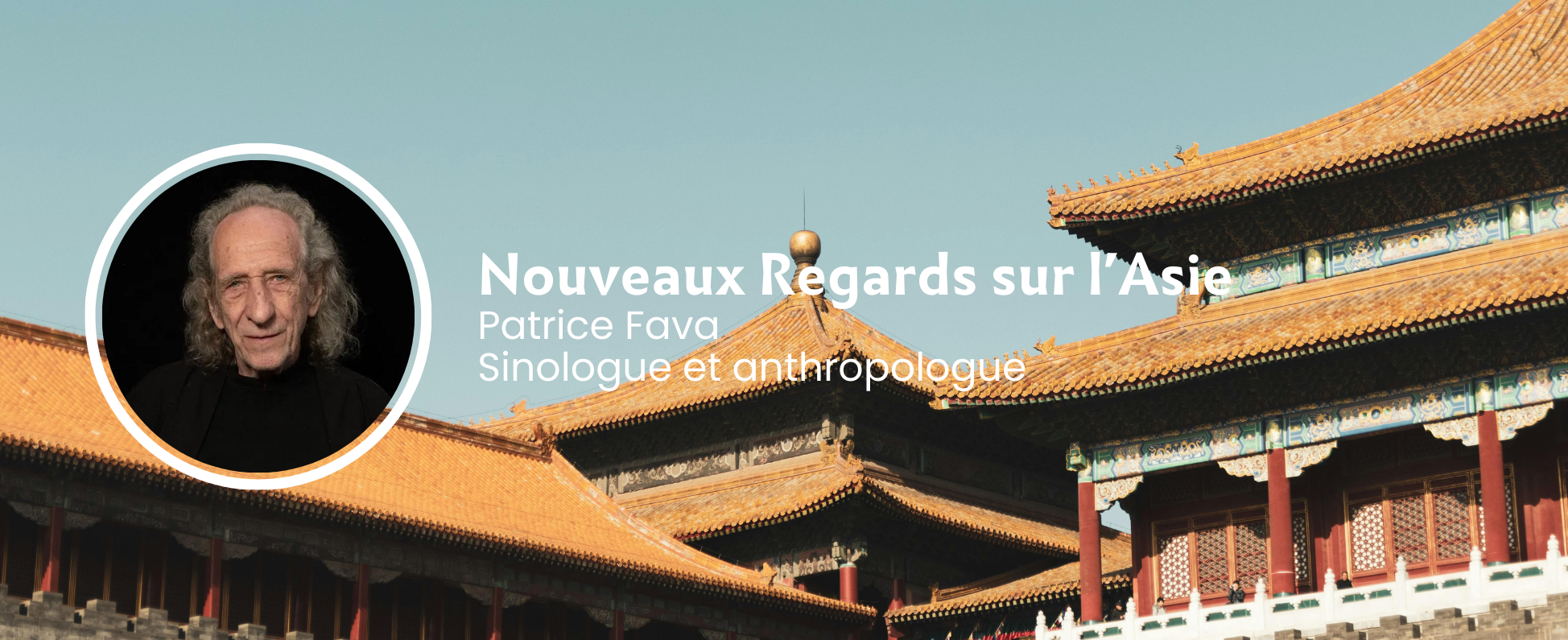
By Patrice Fava
For this first issue of the new year—on which occasion we extend our best wishes—we are pleased to welcome once again in our pages the ethnologist and sinologist Patrice Fava (see “China Remains Terra Incognita,” an interview published in the inaugural April 2024 issue of Nouveaux Regards sur l’Asie). Patrice Fava is notably the author of Un taoïste n’a pas d’ombre – Mémoires d’un ethnologue en Chine, published by Éditions Buchet-Chastel in September 2023, and of Aux portes du Ciel, la statuaire taoïste du Hunan – Art et anthropologie de la Chine, which has just been reissued (November 2025) by Éditions Les Belles Lettres.
Under the round, pale moon of the 14th day of the 10th lunar month (3 December 2025), before the Gate of Fidelity and Submission (Zhenshun men 貞順門), the wait drags on. The president’s plane landed at five o’clock at Beijing airport. He should be here, in principle, within the hour. The night is inky black, and the light of the torches traces arabesques across the paving stones of the emperor’s garden, crossing and gliding along the slabs. Acting as a scout, I cross several courtyards to the other entrance, the southern one, to learn how the visit will unfold and where I will be able to unfold the map which, as in broad daylight, will reveal the magnificence of the yellow-roofed pavilions filling the space.
Nothing has been left to chance in the protocol. It is known who will open the door of the presidential limousine, the exact spot where I must stand, since I will be the first to welcome him, before greeting Madame Macron. These long-awaited reunions are surrounded by as much suspense as during the nighttime visit to the Forbidden City two years ago. Once again, the Palace director accompanies us.
The torches around us guide our steps through a labyrinth of gates and corridors of which only the ground is visible. With Nicolas Idier, the sinologist of the delegation and a long-time close associate of the president, we take turns talking about Qianlong—his reign, the choice of this place where he prepared for retirement, the restoration work, and the fact that of the four courtyards, only two have been accessible to the public since October of this year.
The life of Emperor Qianlong is a long novel.
He ascended the throne at the age of 24, succeeding his father Emperor Yongzheng, who himself had continued the paternal lineage of Kangxi, the Chinese Louis XIV, whose reign lasted 61 years. Qianlong, so as not to overshadow his grandfather, handed over the throne to his son Jiaqing after only 60 years on it, but in fact continued to manage the affairs of the empire. It was also at the age of 60—a pivotal period in life—that he decided to have this garden built in the northeastern part of the Forbidden City in order to retire there.
This was in 1770, and the works lasted six years, mobilizing the finest artisans of the empire. In official history, Qianlong is today regarded as a prestigious monarch who made China the most powerful country in the world, waging victorious wars, while also being a great scholar, a passionate collector, and the most prolific poet of all time.
He thus embodied the two most important aspects of a fully accomplished man: wen 文 (culture) and wu 武 (the martial aspect). He died at the age of 89.
When we finally reach the Pavilion of Former Elegance (Guhuaxuan 古華軒), where a sophora tree once bloomed whose beauty bore witness to the happy era of the emperor’s good governance, the visit can begin. On the left, the labyrinth dug into the ground is in fact the image of a winding river along whose banks, on an afternoon in the year 343, several dozen literati engaged in poetic contests. Cups of wine circulated, pushed by the current, and whenever one passed before a particular guest, he had to empty it and write a poem. A collection of all these verses was published with a preface signed by Wang Xizhi (303–361), which for centuries has been among the greatest treasures of literature and calligraphy.
Passing into the next courtyard, one faces the Hall of the Fulfillment of Vows (Suichu tang 遂初堂), an allusion to another poet and calligrapher, Sun Chuo (314–371), who wrote a Taoist-inspired poem of the same title (Suichu fu 遂初賦), in which he speaks of his desire to live as a hermit far from the turmoil of official duties.
In the three buildings framing this courtyard, exhibitions have been installed, and it is on the display case in the western hall that I can finally unfold the map of the garden, on which I have written the Chinese names of all the buildings, with their French translations beneath.
This panoramic vision of the twenty-five buildings with yellow tiles (the imperial color) is both a relief and a source of wonder. We can imagine the path we have just taken without seeing anything, identify where we are and where we are heading.
Each structure bears an evocative name: Xieshang ting 褉賞亭, the Pavilion of Purification, in memory of a spring ritual; Yi zhai 抑齋, the Studio of Moderation (a Confucian virtue), where the emperor would come to read and meditate; then, moving northward, the Pavilion of the Rays of Dawn (Xuhui ting 旭輝亭), probably positioned to be bathed in the light of the rising sun, a symbol of renewal and the eternal return of day and night.
We then briefly stop at the Pavilion of the Three Friends of Winter (Sanyou xuan 三友軒): the pine 松, bamboo 竹, and prunus 梅, which symbolize longevity, integrity, and resilience respectively, as they remain green or bloom in winter. In this tightly knit architectural space, every location carries a new message, a new project.
The Yanqu lou 延趣楼, which I translated as “The Pavilion of Perpetual Rapture,” thinking of The Ravishing of Lol V. Stein by Marguerite Duras, refers to a key concept (qu 趣) in aesthetics meaning to capture the beauty of a work and to be captured by it—ravish and be ravished.
This interior promenade evokes solitude, introspection, reflection, and contemplation, but it is also a joyful place where sumptuous banquets were prepared or small gatherings held around a cup of tea, in the company of a few beauties from the harem.
Through all these names, one understands that this is a place with a philosophical and spiritual vocation, but also one of pleasure and enjoyment.
A garden, to borrow the title of Rolf Stein’s book, is a “world in miniature” [1], a microcosm that must mirror the macrocosm. Indeed, although Emperor Qianlong, of Manchu origin, was aligned with Buddhism and shamanism, he shared Confucian values and, incidentally, the Taoist vision that prevailed throughout much of Chinese history.
“Everything that exists in the cosmos,” writes Kristofer Schipper, “can be reduced, through a few symbolic signs and a few rites, to a microcosm” [2].
Such is the theoretical substratum at work in the construction of the garden which, through the names given to its pavilions, kiosks, and retreats, reflects the ideals, aesthetics, and aspirations of the emperor. Each term was carefully chosen to evoke a natural scene, a virtue, a state of mind, an ideal of communion with nature, transforming a stroll through this garden into an endless poetic journey. In a word, it is an expression of Chinese thought.
Seen from above, the garden encapsulates the universe of the literati, in which Confucian humanism and the Taoists’ taste for freedom converge. Each of these pavilions invites one to settle there. In the Pavilion of the Gathering of Pleasures, the Cuishang lou 萃賞樓, one admires the finest views of the garden; the Chamber for Cultivating Harmony (Yanghejing she 養和精舍) is conducive to meditation; and in the Residence of Luminous Clouds (Yunguang lou 雲光樓), one draws closer to the heavens. Each has its mystery.
My map of the garden, scribbled with Chinese characters, suddenly gave this visit an indispensable overarching dimension. I am proud to think that it will soon become part of the archives of the Élysée Palace. I added the complete list of pavilions with brief comments and a short text I had written in 2012 after attending the very first inauguration, in the presence of Chinese authorities and representatives of the World Monuments Fund, which had financed the restoration of the garden—known in fact never to have been inhabited by the emperor and to have remained abandoned for nearly two centuries. The British ambassador also spoke on behalf of the Prince of Wales, who was among the contributors.
A cocktail was organized for some three hundred guests before the screening of a film shot over the entire duration of the works by a team of Chinese and British filmmakers. Reports of dissension within the production and the comments that had reached me did not predispose me to expect a masterpiece. This kind of commissioned film requires considerable imagination to avoid falling into the documentary, talkative style that no longer finds an audience in the West. The challenge was perhaps not fully met, but the images nevertheless held great interest, as over the six years of filming one encounters extraordinary individuals who, in the hinterland, still know how to make the paper used as a support for painted decorations, master the secrets of bamboo marquetry, and are capable of recreating, from faded scraps, brocade hangings and chamois-like fabrics for alcoves.
They are all seen at work, repeating the gestures of their predecessors, whose worthy successors they remain five generations later. They have preserved skills in which almost no one has been interested for many years. All the beauty and emotion of the film lie in these sequences and in the back-and-forth between traditional China—alive, active, resourceful, but little known—and the center of power.
After 200 years of slow decay, the palaces, pavilions, corridors, rockeries of the four courtyards built by one of the last Chinese despots are given new life, and some of those who contributed most to the interior decoration come from their distant provinces—Anhui, Fujian, Zhejiang—to see what has become of their work. They are filled with wonder, and with them we weep with joy. When the lights come back on, spectators look at one another as if awakening from a dream. We already knew that despite the many forms of destruction that have multiplied over the past half-century, the Chinese had retained, in almost all fields, the essence of their know-how. This film is striking proof of that, and one can only welcome the international cooperation made possible by the opening-up that, in less than thirty years, has completely transformed China.
That said, one would like to know how the Chinese and British directors who made this film worked, and what pressures they were subjected to in order to remain so perfectly within what is conventionally called “political correctness.” One could indeed have done without the shot of Mao’s portrait in Tiananmen Square, and would rather have liked to see the places of worship that Qianlong had arranged in this residence where he intended to spend his final days.
We know with what fervor he took part in the rites of his original religion, Lamaism, as attested by the pagoda of the Yuhua ge in the Forbidden City, the mandala at the center of which he is represented as the reincarnation of Manjusri [3], or his tomb filled with Sanskrit formulas [4]. But official history has decided, for how long one cannot say, to pretend to ignore that the Forbidden City was also a major religious center. This film celebrating Qianlong should not make us forget that while he left a deep imprint on China’s destiny, he was also one of the architects of its decline. It will probably take another generation of historians to rewrite his story and revisit the garden of the Ningshou gong with a different eye.
After these digressions before the virtual image of the Garden of Longevity and Rest, our Chinese guides lead us into the Belvedere of the Fulfillment of Wishes, Fuwang ge 符望阁, whose name evokes the emperor’s dreams of grandeur and the hope of a happy retirement. This two-story building dominates the entire complex and was reserved for receptions.
It is accessed via a tunnel cut beneath a pile of rocks. Upon exiting, one discovers at the very top the charming Pavilion of the Jade-Colored Conch (Biluo ting 碧螺亭), which appeared as a model in the exhibition, highlighting it as a unique example of architecture in China—though one could hardly imagine it perched atop this rockery and admired for hours from the Fuwang ge Pavilion.
After this glimpse of the site’s architectural genius—so different from that of the Forbidden City—we move on to discover its intimacy and extraordinary sophistication. Every detail invites contemplation. Everything in this secret, empty place, where luxury and beauty converge, belongs to the past of eternal China. One would need countless images to convey the art and perfection of each room, each door, each hanging, each motif. While awaiting the publication of an art book documenting this splendid 18th-century décor recreated identically, one may consult the images available on the World Monuments Fund website [5].
The visit ends in the Studio of Weariness from Diligence, Juanqin zhai 倦勤齋—a well-chosen name—where Qianlong had a small theater built. One tries to imagine what was performed there while gazing at the large mural painting attributed to the famous Italian painter Giuseppe Castiglione, also known as Lang Shining 郎世寧, who lived for more than fifty years at the Beijing court and painted numerous portraits of Qianlong [6].
That the president’s arrival in China should begin with this backward glance is no coincidence. He too needs to build bridges between today’s China and that of yesterday. This visit was charged with deep emotion for everyone.
[1] Rolf Stein, Le monde en petit, jardins en miniature et habitations dans la pensée religieuse d’Extrême-0rient, Flammarion, 2001.
[2] Kristofer Schipper, La religion de la Chine, La tradition vivante, Fayard, 2008, page 214.
[3] Ed. note: Manjusri/Mañjushrī (Le Vénéré purifié) est le Bodhisattva (celui qui a atteint la bouddhéité) de la sagesse transcendante (prajna), l’un des plus connus du bouddhisme mahāyāna (du grand véhicule).
[4] See in particular: Françoise Wang-Toutain, « Les cercueils du tombeau de l’Empereur Qianlong », Arts asiatiques, vol. 60, n° 1, 2005, pp. 62-84, et Patrice Fava, « Les temples et la vie religieuse dans la Cité interdite sous les dynasties Ming et Qing », dans le catalogue de l’exposition La Cité interdite à Monaco, Vie de cour des empereurs et impératrices de Chine, ouvrage publié sous la direction de Jean-Paul Desroches, Skira, 2017, pp. 174-201.
[5] Photographs and a ten-minute video of rather poor quality entitled “Journey to the Qianlong Garden in Beijing” are available on this site: https://www.wmf.org/events/qianlong-garden-china
[6] Michèle Pirazzoli-T’sertevens, Guiseppe Castiglione, 1688-1766, Peintre et architecte à la cour de Chine, Thalia édition, 2007 ;. reproduction in https://www.clevelandart.org/art/1969.31.
*****
Patrice Fava, a sinologist and anthropologist, is the author of several works, including Aux portes du ciel, la statuaire taoïste du Hunan, Art et anthropologie de la Chine (Les Belles Lettres, 2013); L’usage du Tao (Jean-Claude Lattès); Un taoïste n’a pas d’ombre – Memoirs of an Ethnologist in China (Buchet-Chastel, 2023), as well as numerous articles in French, English, and Chinese. A former Attaché at the French Embassy in Beijing (1970–1972), he later became an associate researcher at the Beijing Center of the École Française d’Extrême-Orient and at the Taoist Research Center of Renmin University. He has been based in China for nearly fifty years.
