
Hope in a small country: Timor-Leste.
02/04/2026
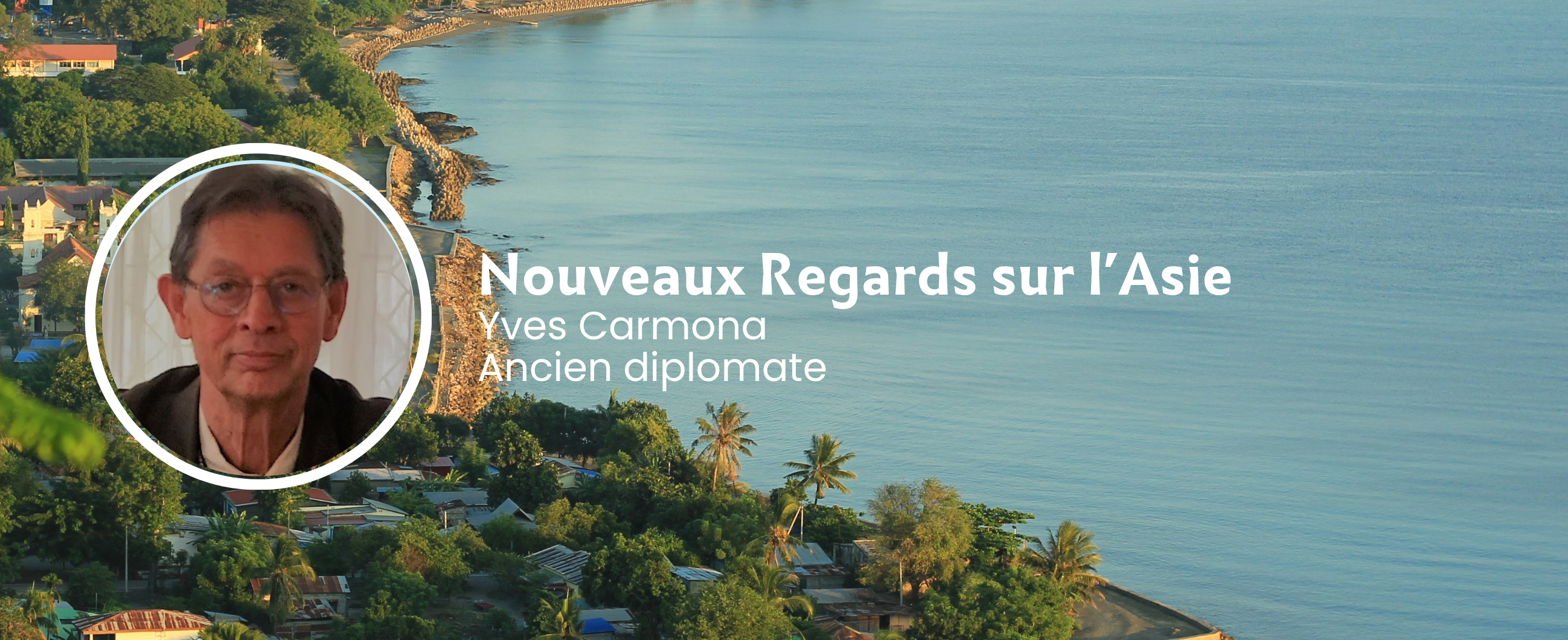
By Yves Carmona
Why write about this remote little country, about which the author of these lines already said everything there was to say on 2 July 2023? Nothing happens there, no one goes there, there are few inhabitants on this remote piece of island closer to Australia than to Southeast Asia, of which it is the easternmost country, and then there are the whims of the President of the United States, whose commentators ponder learnedly what his next move will be. That's more interesting, isn't it?
Well, no, precisely because this is a country whose President has long been a Nobel Peace Prize laureate, while Mr. Trump is still waiting. President Horta received this distinction in 1996, not because he had resolved external conflicts, but for having valiantly resisted the invasion of his country by its greedy neighbour?
What has just happened, unbeknownst to most of our readers, is the admission of Timor-Leste into ASEAN on 26 October 2025. It will be the 11th member country and probably the last.
To the applause of the heads of state and government gathered as usual at a summit, this time in Kuala Lumpur, the capital of Malaysia, President José Ramos-Horta and Prime Minister Xanana Gusmao welcomed the decision, especially since Timor-Leste had applied for membership in 2011.
Why such an unusually long delay? Because Indonesia and a few others had consistently opposed it, unable to accept that the country its big neighbour had invaded in 1975 and which had resisted at the cost of hundreds of thousands of lives had nevertheless gained independence in 2002.
So Timor-Leste is finally a member of ASEAN, but what will this bring? More specifically:
Who are the main donors and what do they do?
What markets will open up to it?
What will it gain in terms of international reputation?
The information available to answer these questions is fragmentary, but we can attempt to answer them.
1. Major lenders:
Australia, the Asian Development Bank, the European Union and Japan are the main donors, with China increasing its contribution. However, it should be noted, especially in light of the United States' flip-flopping and the lack of interest from other wealthy countries, that this government is doing its best to rely primarily on itself.
It is striving to build a more resilient economy in this monsoon-prone part of Asia and to reduce dependence on oil: first and foremost, to improve the lot of all.
Timor-Leste's development programme is based on its 2011-2030 Strategic Development Plan, which prioritises social capital (health, education, social protection), basic infrastructure and diversification beyond oil, while aligning spending with the Sustainable Development Goals (SDGs).
Key investments made with development partners include climate-resilient roads, major projects in water, sanitation, energy, urban planning, education and health, and the expansion and modernisation of Dili Airport to improve the international connectivity needed for tourism and trade.
These efforts are also funded by the government through the Petroleum Fund, a sovereign wealth fund of approximately US$19 billion that separates oil revenues from the budget and is intended to support both current development and future generations, although some warn that it could be depleted by 2038 without stronger non-oil growth and fiscal discipline.
With the Bayu-Undan fields now depleted, the government is seeking to advance new oil and gas projects, including the Tasi Mane project, the Greater Sunrise development and the Bayu-Undan transition, balancing their potential with the need to avoid excessive dependence on hydrocarbons.
2. Opening up markets:
It is undoubtedly in this area that this small country, one of the poorest in Southeast Asia, has the most to gain. Being part of ASEAN means access to an economy worth $3.8 trillion and 680 million people, compared to its own GDP of just £1.9 billion, shared among 1,521,000 people. The centrality of ASEAN, an obsession for its members, means that membership provides an opportunity to rub shoulders not only with the 10 other members, even though it is located at its eastern end, closer to Australia than to Indonesia, by far the most populous member but whose capital Jakarta is 4,500 km from Dili.
This means:
More opportunities for local businesses to grow and export, particularly in agriculture (coffee, spices, horticulture), tourism and digital services.
More foreign investment and jobs.
ASEAN membership will help attract foreign investors who will bring capital, technology and know-how. This will create more jobs, particularly for young people, and contribute to the development of important sectors such as tourism, transport and digital services.
Improved infrastructure and connectivity. ASEAN membership will make it easier for Timor-Leste to improve its roads, ports, airports and internet access. This will help businesses operate more efficiently and make it easier for tourists and investors to visit the country.
Support for small and medium-sized enterprises (SMEs) will be improved through access to ASEAN programmes that offer training, digital skills and easier ways to trade with other countries. This support can help local entrepreneurs grow and compete regionally.
Marketing will be less expensive and faster thanks to ASEAN trade agreements and systems (such as the ASEAN Single Window): these will make importing and exporting goods simpler, less expensive and faster. This means that businesses will be able to save time and money when trading with other ASEAN countries.
Timorese professionals and students will have more opportunities to work, study and train in other ASEAN countries. This will allow them to gain skills and experience that they can then put to good use in Timor-Leste.
ASEAN membership will raise Timor-Leste's profile as a tourist destination, as experience shows that many trips include visits to other well-known tourist destinations in the region, such as Bali. Regional tourism campaigns and the facilitation of travel within ASEAN can attract more visitors, which will stimulate local businesses and create jobs in the hospitality and tourism sectors.
3. International reputation:
The President and Prime Minister, who do not often leave their country, took advantage of their trip to Kuala Lumpur to go to Delhi to meet once again with the President of ‘the world's largest democracy’. And yet Mr Horta and Mr Gusmao are closely monitored by their domestic public opinion: it is not a question of spending public money recklessly.
Beyond this example, Timor-Leste will gain a stronger voice in regional and global discussions and international recognition. Let us not forget that each of the now 11 rotating presidencies offers the country hosting the summit of heads of state and government the opportunity to welcome not only the other ASEAN members, but also an increasing number of other countries, including Japan, China and South Korea (ASEAN + 3), as well as Australia, China, New Zealand, Russia and the United States. As one of the few democracies in the region, Timor-Leste contributes to maintaining peace and stability.
Conclusion:
Small, poor and remote, this is a country that poses no threat to anyone and whose inclusion in the international community offers a rare hope for progress at a time when the largest countries seem to favour authoritarianism.
It has become fashionable lately to blame globalisation for all evils. Doesn't Timor-Leste show, on the contrary, that it is preferable to tenaciously break out of isolation and integrate into a larger entity that respects identities, particularly numerous and diverse in ASEAN, which allows it both to better export its products and to diversify its opportunities for political dialogue?
*****
A former student of the École Nationale d’Administration (ENA) and a career diplomat, Yves CARMONA spent most of his career in Asia: twice posted as Counsellor for Foreign Affairs in Japan, then as Deputy Chief of Mission in Singapore, and later as Ambassador to Laos and Nepal (2012–2018). In these positions, as well as in those he held in Paris, he focused—drawing also on his background as a student of Japanese—on the rapid transformations of Asian countries and their relations with France and Europe. Now retired, he is committed to sharing his experience with those who may benefit from it.
This publication reflects the views and opinions of the individual authors. As a platform dedicated to the sharing of information and ideas, our objective is to highlight a diversity of perspectives. Accordingly, the opinions expressed herein should not be interpreted as those of the Fondation France-Asie or its affiliates.
