
Interview Nouveaux Regards with Clara Chappaz.
11/06/2026
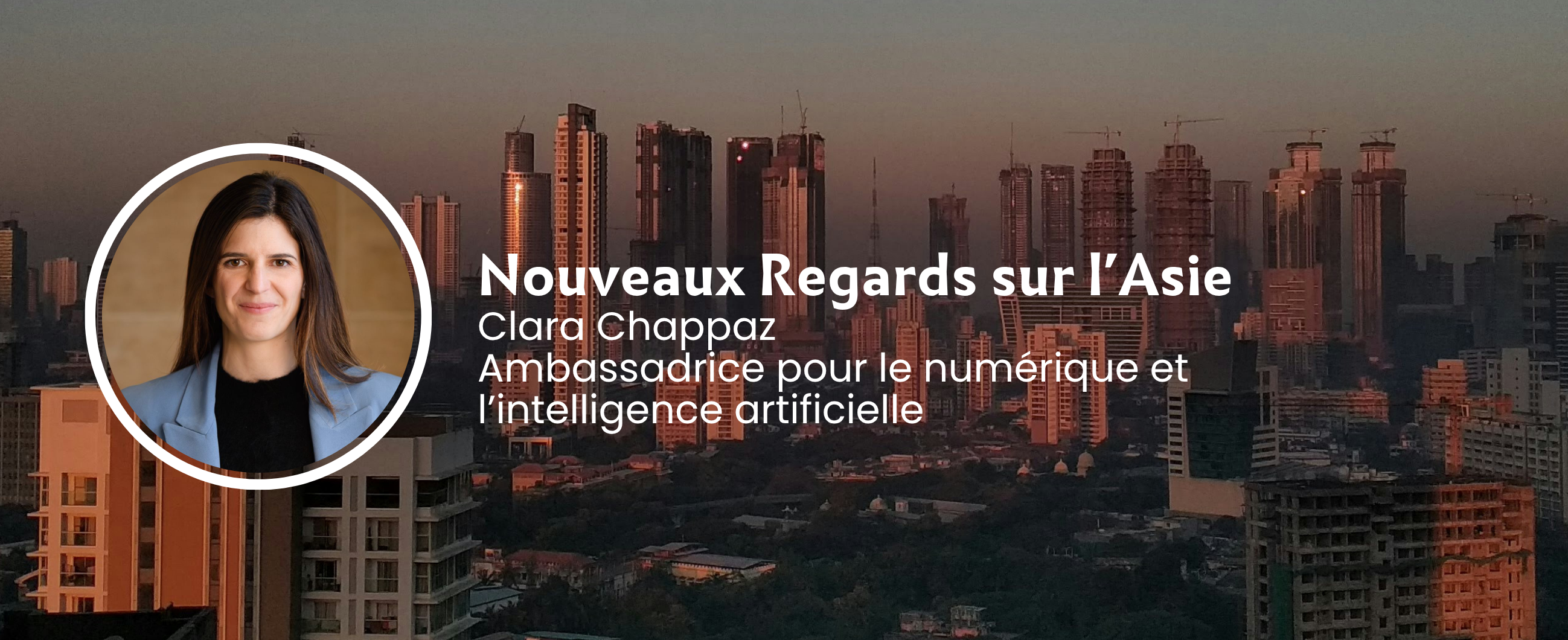
Reflections on the New Delhi AI Impact Summit.
Interviewed by the Fondation France-Asie
Fondation France-Asie : In your view, what are the main lessons to be drawn from the AI Impact Summit in New Delhi, particularly for France and Europe?
Clara Chappaz : Artificial intelligence is the geopolitical challenge of our generation. At the New Delhi summit, organized by India as a direct follow-up to the Paris summit that we co-chaired, this conviction has ceased to be a matter of debate and has become a shared reality. A global power struggle pits a handful of states and companies that hold the keys to this technology against the rest of the world.
The question raised in New Delhi was a simple one: who will write the rules governing AI, which already shapes access to information, structures public services, and influences the online behavior of our children?
France and India achieved a concrete result: thirteen leading model developers committed to publishing data on the real-world use of their systems and to testing their models in underrepresented languages. States acting together can influence private-sector actors.
To what extent did the summit help establish a more concrete and operational vision of international cooperation in artificial intelligence?
New Delhi moved the debate forward on three fronts.
First, capabilities: a Franco-Indian research centre for health and AI was inaugurated at AIIMS Delhi as part of the Franco-Indian Year of Innovation. Researchers from both countries are now working together on concrete projects using real-world infrastructure.
Second, transparency: major platforms committed to documenting their training data and taking multilingualism into account. A user in Hindi or French should be able to trust a model that has been tested in their own language.
Third, the protection of minors: France and India share a common approach to regulating recommendation systems targeting adolescents. France promotes this issue during all of its engagements in Asia and will continue to do so at the G7 Summit in Évian this June. We have also launched an international call for contributions from scientists worldwide on the protection of minors in the age of AI.
What are currently the main challenges and opportunities of Franco-Indian cooperation in artificial intelligence?
The Franco-Indian relationship has been elevated to the status of a special comprehensive strategic partnership. No other Western country has developed such a strategic relationship with India. This achievement is the result of long-term cooperation. AI lies at the heart of this partnership, itself rooted in a shared conviction: technological independence is a prerequisite for sovereignty.
In Delhi, more than 200 universities and research institutes from both countries came together, and around twenty universities signed partnership agreements. A joint centre of excellence for AI in healthcare was inaugurated. These are the building blocks of a common architecture.
India brings world-class digital talent and the legitimacy of a market of 1.4 billion people. France contributes academic excellence and decarbonized energy. Both countries share a vision of technology serving citizens.
What specific strengths can France and India combine to build an ambitious partnership in research, innovation, talent development, regulation, and large-scale deployment?
France possesses outstanding capabilities in fundamental research in AI and quantum technologies through institutions such as CNRS, Inria, and CEA. India benefits from an unparalleled engineering ecosystem and the ability to deploy innovations at continental scale. Together, we cover the entire value chain, from research to application.
A concrete example is Current AI, the initiative launched at the Paris Summit to develop AI models adapted to underrepresented languages and cultures. India, with its exceptional linguistic diversity, is a natural partner for this endeavour.
How do you assess France's position in the global race for technological leadership, particularly in artificial intelligence?
France has been Europe's leading destination for foreign investment for seven consecutive years. In AI specifically, it hosts the largest number of AI startups in Europe — more than 1,000 companies — with record levels of fundraising. Mistral AI is valued at more than €11 billion. France is home to world-class AI clusters, notably in the Paris region, Grenoble, and Toulouse.
This position is the direct result of policies initiated by the President of the Republic since 2018, beginning with the first national AI strategy, followed by France 2030 and the Paris Summit. Each step has reinforced the ecosystem through decarbonized energy, research infrastructure, a clear regulatory framework, and talent attraction.
Our diplomacy also allows us to project influence and rally partners. The Paris AI Action Summit generated €109 billion in commitments. Choose France 2026 confirms this momentum with massive investments in AI infrastructure on French soil.
At a time when some European countries appear to be reducing or slowing investment in research and development, how can France preserve and strengthen its competitive advantage?
By investing heavily to build our technological sovereignty. Europe is now affirming the need to control its own infrastructures. In AI and quantum technologies, France is mobilizing all available resources to build competitive and sustainable industrial ecosystems.
The President recently announced an additional €1.55 billion for quantum technologies and semiconductors. A consortium of 28 French companies has unveiled plans for an AI gigafactory worth more than €10 billion. At Choose France, SoftBank announced €75 billion in investments in the Hauts-de-France region. Schneider Electric is building a factory in Dunkirk, while Foxconn and Bull have signed a semiconductor partnership in Angers. Every foreign investment helps strengthen a French actor.
The strategy is clear: public investment initiates momentum, private capital amplifies it. This synergy is visible at every edition of Choose France. The next challenge lies at the European level: completing the Capital Markets Union to ensure European companies have access to the financing required to scale up.
Which levers should be prioritized to make France not only a country of scientific excellence, but also one capable of transforming that excellence into industrial and technological champions?
Financing comes first. French startups must be able to secure funding in Europe at every stage of their growth. Too many promising companies still seek funding in the United States or Asia because equivalent resources are unavailable here.
Public procurement comes next. When European administrations choose solutions developed by European companies for critical functions, they send a strong market signal and strengthen the credibility of the ecosystem.
Finally, simplification. Companies need the ability to grow quickly. Faster authorization procedures, easier access to land for data centres and factories, and accelerated energy permitting are all essential. Foreign investors repeatedly tell us that France has strong fundamentals, but administrative simplification often determines the final investment decision.
Beyond India, how do you envision France's cooperation with major Asian countries such as Japan, China, and South Korea in artificial intelligence and digital technologies?
The principle guiding our digital diplomacy is simple: together, we are less dependent on a handful of actors. And less dependence means less vulnerability.
Japan is our oldest scientific partner in Asia. CNRS and the University of Tokyo have shared a joint laboratory for decades. During the President's State Visit in March 2026, the relationship reached a new level with a bilateral declaration on AI and direct industrial agreements between French startups and major Japanese corporations.
South Korea established a comprehensive strategic partnership with France in April 2026. Korea brings exceptional industrial execution capabilities, while France contributes world-leading fundamental research. The Federation of Korean Industries forum demonstrated the potential of this complementarity, particularly in photonic quantum technologies.
With China, dialogue is both necessary and demanding. China is simultaneously a partner and a competitor in AI. Discussions focus on technical standards, system security, and model governance. France protects its critical assets and remains clear-eyed about the balance of power. Yet dialogue must continue, because challenges ranging from AI governance to climate change and digital disarmament require all major powers to be at the table.
Can France act as a bridge between Europe and Asia to promote an artificial intelligence that is innovative, sovereign, open, and responsible?
France is conducting intensive, high-level diplomatic engagement on digital and AI issues. Recent visits to Japan, South Korea, and India are direct illustrations of this effort: our objective is to build concrete industrial partnerships on the ground.
Faced with the Sino-American technological duopoly, we are building a third path together with our Asian and international partners — one based on open alliances, reciprocity, and shared sovereignty.
To achieve this, France's strategy rests on three complementary pillars: a political vision, a regulatory framework, and concrete industrial agreements capable of turning ambitions into reality.
You accompanied the presidential delegation to Japan and South Korea. What concrete examples of bilateral cooperation in AI and digital technologies can you share following these visits?
In Japan, LIMMS — the CNRS Franco-Japanese laboratory in Tokyo — demonstrates what research can achieve when given time and trust: the encryption of a message using synthetic DNA between Paris and Tokyo, a world first. Alain Aspect was present. That moment alone encapsulates thirty years of joint work.
On the industrial side, Mistral AI signed an agreement with NTT Data to deploy its models in Japan. Current AI, the initiative launched at the Paris Summit, concluded a partnership with Sakana AI. Exotrail joined forces with Astroscale in the field of space logistics. In the course of a single State Visit, three agreements were signed directly connecting our ecosystems.
In South Korea, the deep-tech session of the FKI forum brought together the leaders of Quandela and Pasqal with their Korean counterparts in quantum technologies. Discussions were frank, technical, and operational. Quandela is opening a photonic quantum research hub at KAIST. Twelve agreements were signed overall, ranging from AI to semiconductors.
More broadly, how do you see French digital diplomacy evolving in the coming years, particularly with regard to Asia's major technological powers?
Digital diplomacy is now becoming a pillar of France's foreign policy, alongside economic and climate diplomacy. Artificial intelligence is reshaping global balances of power.
Asia concentrates much of the industrial capacity, talent, and markets that will shape tomorrow's AI. With each Asian partner, our approach is to diversify alliances and build together by deploying researchers and businesses on the ground.
In the years ahead, this diplomacy will intensify around two priorities. First, the democratic imperative: protecting minors and combating disinformation in the age of generative AI are urgent challenges that transcend borders. We must build these safeguards together with our Asian partners now. Second, industry: the goal is to establish permanent innovation corridors between France and Asia so that agreements signed during State Visits evolve into sustainable and sovereign industrial projects.
Being a technological power requires making clear-eyed choices about dependencies and investing in alliances that strengthen us. France is building this path every week alongside its partners.
*****
Clara Chappaz has served as France’s Ambassador for Digital Affairs and Artificial Intelligence since December 2025, attached to the Ministry for Europe and Foreign Affairs. Between September 2024 and September 2025, she served as Minister Delegate and subsequently as Secretary of State for Artificial Intelligence and Digital Affairs in the Bayrou and Barnier governments. It was the first time that artificial intelligence appeared in the title of a ministerial portfolio in France. From 2021 to 2024, she led the French Tech Mission, supporting the growth and international expansion of the French startup ecosystem. During this period, she developed a Gender Equality Pact signed by more than 700 startups. Her career was built within the international technology startup ecosystem: Chief Business Officer at Vestiaire Collective, head of international expansion at Lyst in London (backed by LVMH), and senior leadership positions at Zalora in Southeast Asia. During her MBA at Harvard, she co-founded Lullaby, a marketplace dedicated to second hand children's products.She graduated from ESSEC Business School, holds an MBA from Harvard Business School, and is an auditor of the Institute for Advanced Studies in National Defence (IHEDN).
This publication reflects the views and opinions of the individual authors. As a platform dedicated to the sharing of information and ideas, our objective is to highlight a diversity of perspectives. Accordingly, the opinions expressed herein should not be interpreted as those of the Fondation France-Asie or its affiliates.
